There is no single maintenance interval that suits every trace heating system. Frequency should be based on asset criticality, consequence of failure, environment, cable and control type, manufacturer guidance, site rules and previous condition. Frost-protection circuits should be proven before the cold season; critical process systems may need more frequent monitoring or planned checks.
The objective is not simply to complete an annual tick-box test. It is to identify deterioration early enough to protect continuity, safety and product quality.
Use risk to set the interval
A short drain line in a low-consequence area does not carry the same risk as a fire-water line, chemical dosing line or process pipe whose loss stops production. Rank circuits by consequence, detectability and exposure. Higher-risk systems justify shorter intervals, stronger records, alarm review and clearer ownership.
Plan a pre-winter inspection
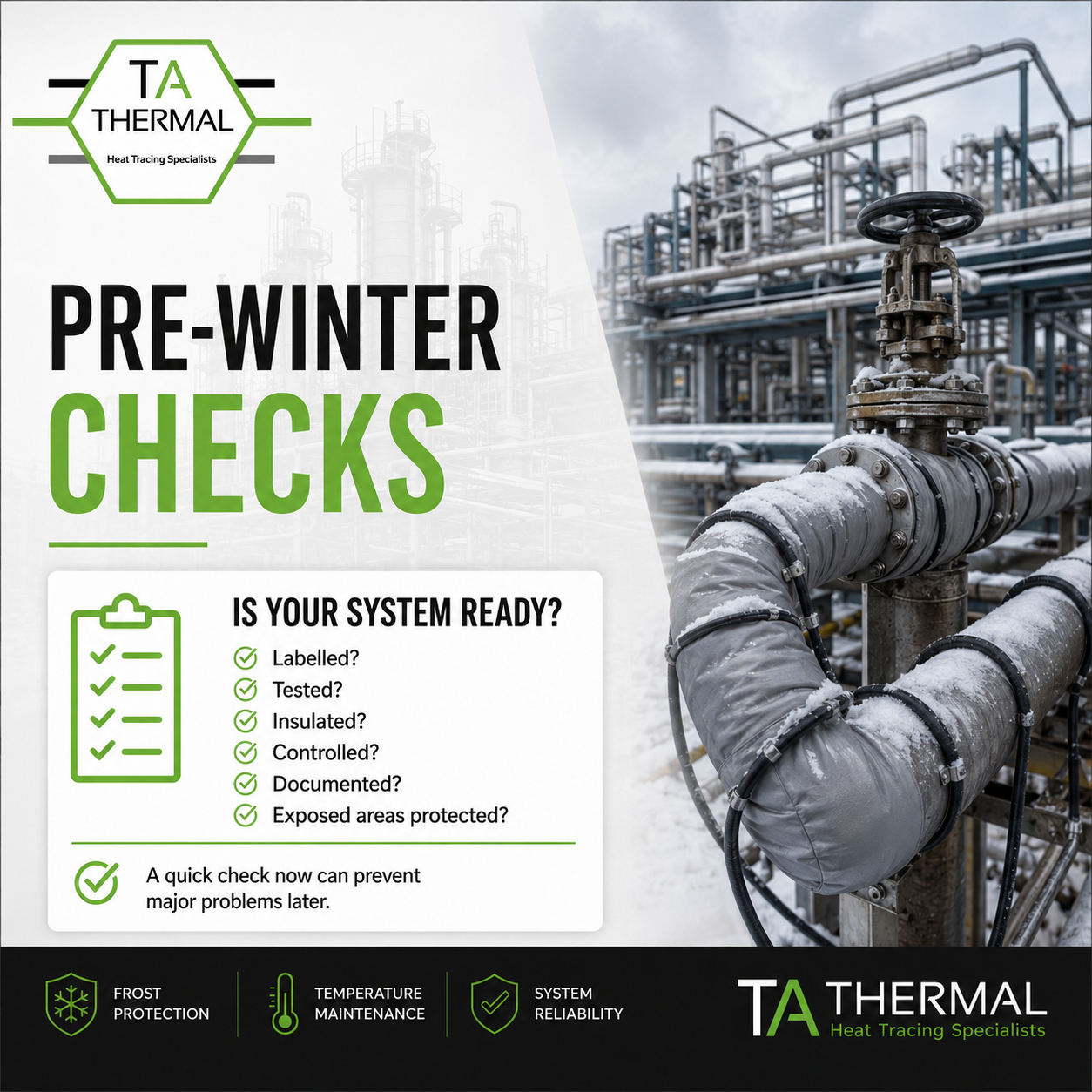
For frost protection, schedule enough time before winter to inspect, test, repair and reinstate insulation. Waiting until forecasts turn cold leaves little time for access, materials or shutdowns. The review should include distribution and controls, not only visible cable terminations.
Inspect after work or disturbance
Additional checks are sensible after pipework modification, insulation replacement, cladding work, a trip or alarm, water ingress, mechanical impact or an unexplained temperature excursion. These events can damage a circuit between scheduled inspections. Contractors working near traced assets should understand that apparently robust outer cladding may conceal a vulnerable cable.
What planned maintenance should cover
A useful visit reviews records, confirms circuit identification, inspects accessible components, completes appropriate electrical tests, checks controls and sensors, and assesses insulation and cladding condition. Defects should be prioritised by operational risk, and repaired circuits should be retested and functionally proven.
Trend data is more useful than isolated results. Stable readings build confidence; a changing value can trigger investigation before failure. Consistent test methods and circuit references are essential if results are to be compared.
Avoid two common maintenance gaps
First, do not assume a building-management or control display proves cable integrity. It may confirm only that a command or sensor is present. Second, do not let ownership fall between electrical, mechanical and process teams. Name the person or function responsible for the asset register, inspection plan and defect close-out. By appointing our services we will do this on your behalf.
A practical starting framework
Create or verify the circuit register; classify criticality; define pre-winter and process-specific checks; add event-driven inspections; standardise test sheets; and review recurring defects annually. The final interval should then be approved within the site maintenance and electrical-safety system.
TA Thermal basic service plan
A basic TA Thermal service plan starts from £500, subject to site location, circuit quantity, access, documentation and the agreed testing scope. Installation work is priced case by case because cable type, design duty, access, controls, insulation and hazardous-area requirements can materially change the work involved.
A site survey is the best starting point where records are incomplete or the circuit condition is unknown. It allows the service scope and priorities to be based on the actual installation rather than a generic allowance.
Key takeaway
Trace heating maintenance should be timed around risk and need, not a universal calendar rule. A planned, recorded pre-season or duty-based programme is far less costly than emergency work after freezing or process loss.
Frequently asked questions
Should self-regulating cable still be maintained? Yes. Self-regulating output does not protect terminations, controls, insulation or cable from damage and ageing.
Is an annual test always enough? Not necessarily. Critical, harsh-environment or frequently disturbed circuits may require more frequent checks or monitoring.
When should frost-protection testing be completed? Early enough before expected cold weather to allow access, repair, retesting and insulation reinstatement.
How much does a basic trace heating service cost? TA Thermal basic service plans start from £500, subject to site, access, number of circuits, documentation and agreed scope. Installation is priced case by case.
The recommended next step is a site survey. TA Thermal can review the asset, existing information, controls, insulation and electrical condition before defining the work required. Call 0115 683 9540 or email info@tathermal.co.uk.