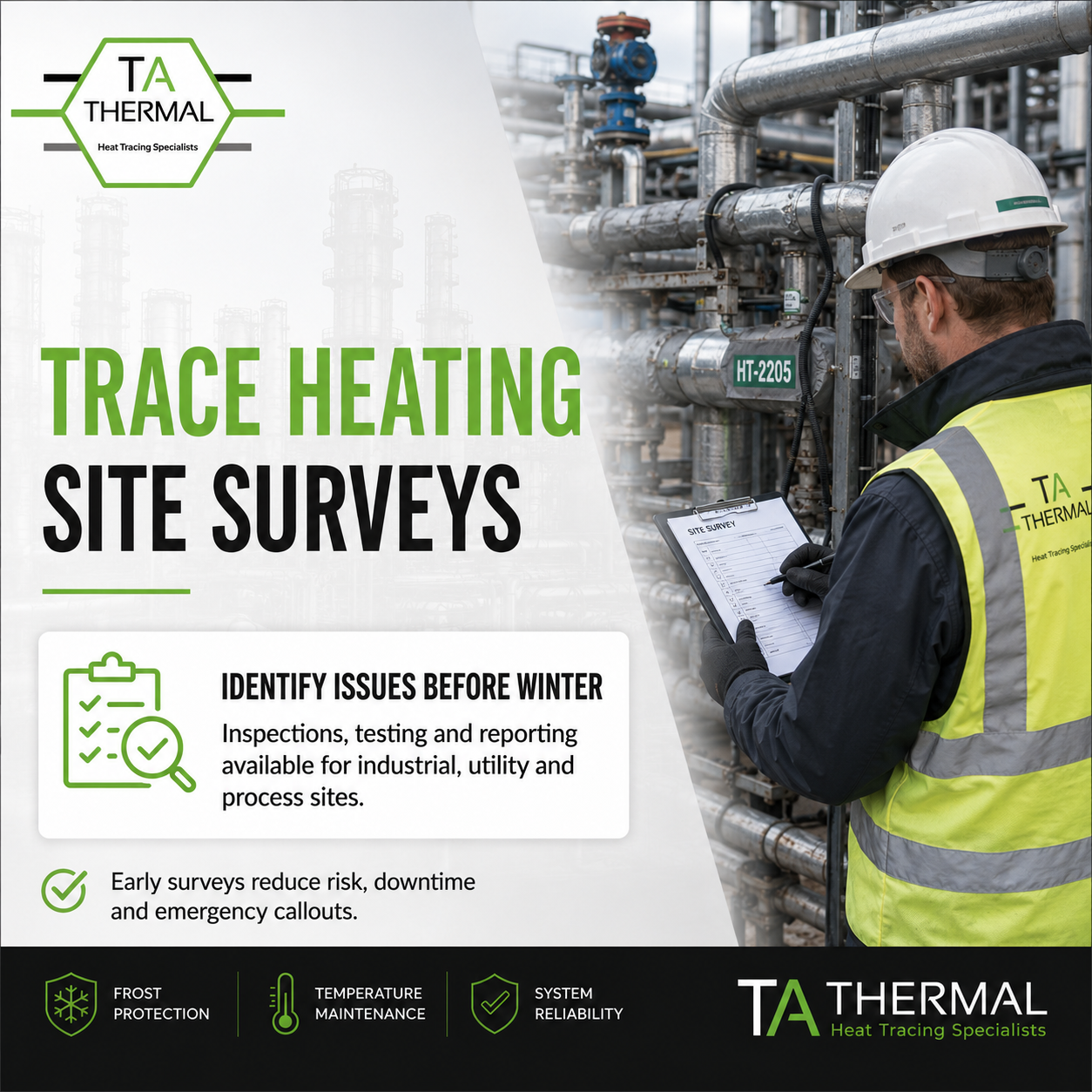
An industrial trace heating system is tested through a controlled sequence of document review, visual inspection, electrical testing and functional checks. The exact method and acceptance criteria must follow the cable manufacturer, approved design, site procedures and applicable electrical or hazardous-area requirements.
Testing should be completed by competent personnel. Circuits must be safely isolated where required, and live functional testing must only be performed under an appropriate safe system of work.
Start with the design and circuit records
Before instruments are connected, confirm the circuit identity, cable type, design length, voltage, protection, controller and expected duty. Previous test results are valuable because trends often reveal deterioration before a circuit fails completely. A test result without a circuit reference or comparison point has limited maintenance value.
Carry out a visual inspection
TA Thermal starts testing before the site visit by reviewing the available drawings, circuit schedules, test sheets and operating information. If documents are absent or unreliable, the site inspection becomes deeper because circuit identity, arrangement and condition must be established from the installation itself.
Before tools are used, inspect accessible power connections, end terminations, junction boxes, glands, earthing arrangements, warning labels, sensors and local damage. Practical details matter: are junction boxes incorrectly spurred from one another, are cover screws missing, are suitable lagging-entry kits fitted, and are stands or pipe-mounted brackets secure and appropriate? Also look for water ingress, corrosion, disturbed covers, crushed cable, improvised joints and missing insulation or cladding.
Complete the required electrical tests
Typical checks include continuity or circuit resistance, insulation resistance and confirmation of protective conductor and circuit protection arrangements. Recorded values must be interpreted against the cable type, length, temperature, manufacturer data and previous results. A single generic pass value should not be applied blindly to every system.
Testing may be required at several stages: after delivery, after cable installation, after terminations, after insulation and before energisation. This staged approach helps identify when damage occurred and avoids discovering a hidden defect only after the pipe is fully clad.
Prove the controls and sensor
A healthy cable is not enough if the thermostat, contactor, electronic controller or sensor is incorrectly set or not switching. Where a control panel is fitted, the functional inspection can include operating selector switches, confirming that contactors pull in and checking the correct operation of indication lamps. Functional checks should also verify control setpoints, alarm behaviour where fitted, output to the correct circuit and realistic sensor readings. Sensor position matters: a sensor placed in an unrepresentative warm or cold location can control the system incorrectly.
Safely isolate and test the heating circuit
On a simple system, TA Thermal proves safe isolation before entering the enclosure or disconnecting the heating cable. The heating circuit can then be separated from other components as required. A resistance test is completed to assess the heating circuit, followed by an insulation-resistance test to assess electrical insulation integrity. Both results are recorded against the correct circuit. Where the circuit arrangement and access allow, testing from both ends can provide additional diagnostic information.
The exact test voltage, connections, limits and interpretation depend on the cable system, connected equipment, manufacturer guidance and site procedure. This work should only be carried out by competent personnel using an appropriate safe system of work.
Confirm operation and document the result
Where safe and appropriate, energisation checks can confirm supply voltage, operating current and response of the circuit. These readings should be assessed against design expectations, allowing for cable and ambient temperature. Any abnormal result needs investigation rather than adjustment until it looks acceptable.
The final record should identify the asset and circuit, test date, instruments, readings, settings, defects, corrective actions and person completing the work. Photographs and a marked-up circuit schedule make future fault finding considerably faster.
What a test cannot prove on its own
An electrical pass does not confirm adequate thermal performance if insulation is missing, process conditions have changed or the original design was unsuitable. Testing is strongest when combined with inspection of the complete system and, for critical duties, verification that the asset reaches or maintains the required temperature.
Key takeaway
Good trace heating testing proves more than a single electrical result. It combines measured circuit resistance and insulation resistance with the installed condition, controls, protection, identification and records needed to trust the system when it is required. The timing of the test also matters — if a product is running warm through a self-regulating system the resistance will change.
Frequently asked questions
How often should trace heating be tested? Frequency should be risk-based and reflect criticality, environment, manufacturer guidance and site maintenance policy. Frost-protection systems are commonly checked before winter.
Can insulation resistance be tested after lagging? Yes, and it is important to test after insulation because cable damage can occur during cladding work. Access and manufacturer requirements must still be followed.
What should be on a trace heating test sheet? Circuit identity, cable details, instrument information, test readings, control settings, defects, actions, date and responsible competent person.
The recommended next step is a site survey. TA Thermal can review the asset, existing information, controls, insulation and electrical condition before defining the work required. Call 0115 683 9540 or email info@tathermal.co.uk.