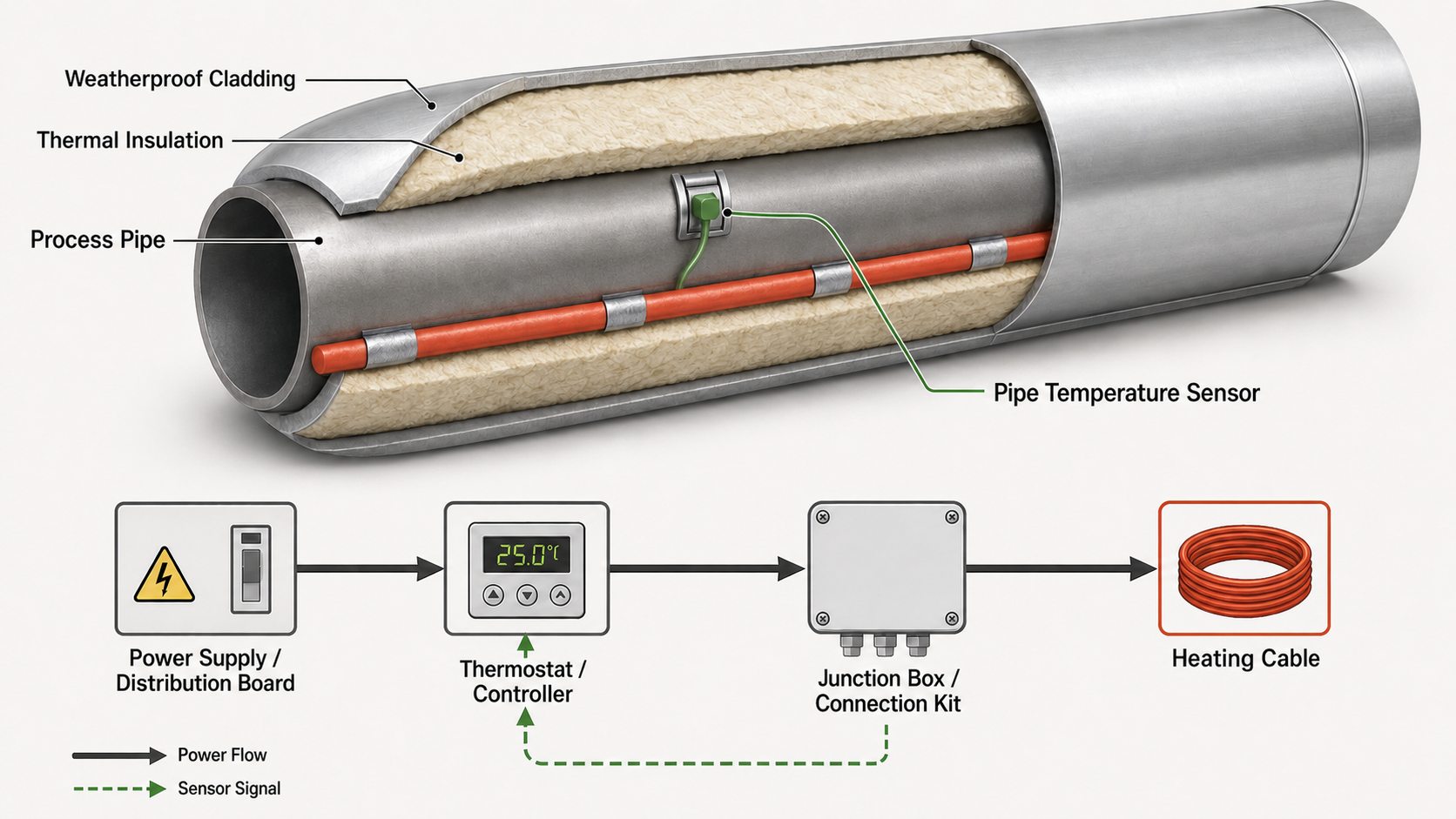
In most industrial frost-protection and temperature-maintenance applications, yes: trace heating and thermal insulation are designed to work together. The cable adds heat to the asset, while the insulation slows the rate at which that heat escapes.
If the installed insulation is thinner, wetter or less effective than the design assumes, the heating system may fail to maintain temperature even though it is electrically healthy.
Trace heating and insulation have different jobs
Thermal insulation does not create heat. It reduces heat transfer between the pipe or equipment and its surroundings. Trace heating provides the energy needed to replace the remaining calculated heat loss. The designer selects cable output and control based partly on the insulation material and thickness.
What happens when insulation is missing
An uninsulated pipe loses substantially more heat to cold air and wind. The cable may run for longer, consume more energy and still fail to protect the most exposed points. Local gaps around valves, flanges, supports or instruments create cold spots even when straight pipework is correctly insulated.
Why wet insulation is a serious problem
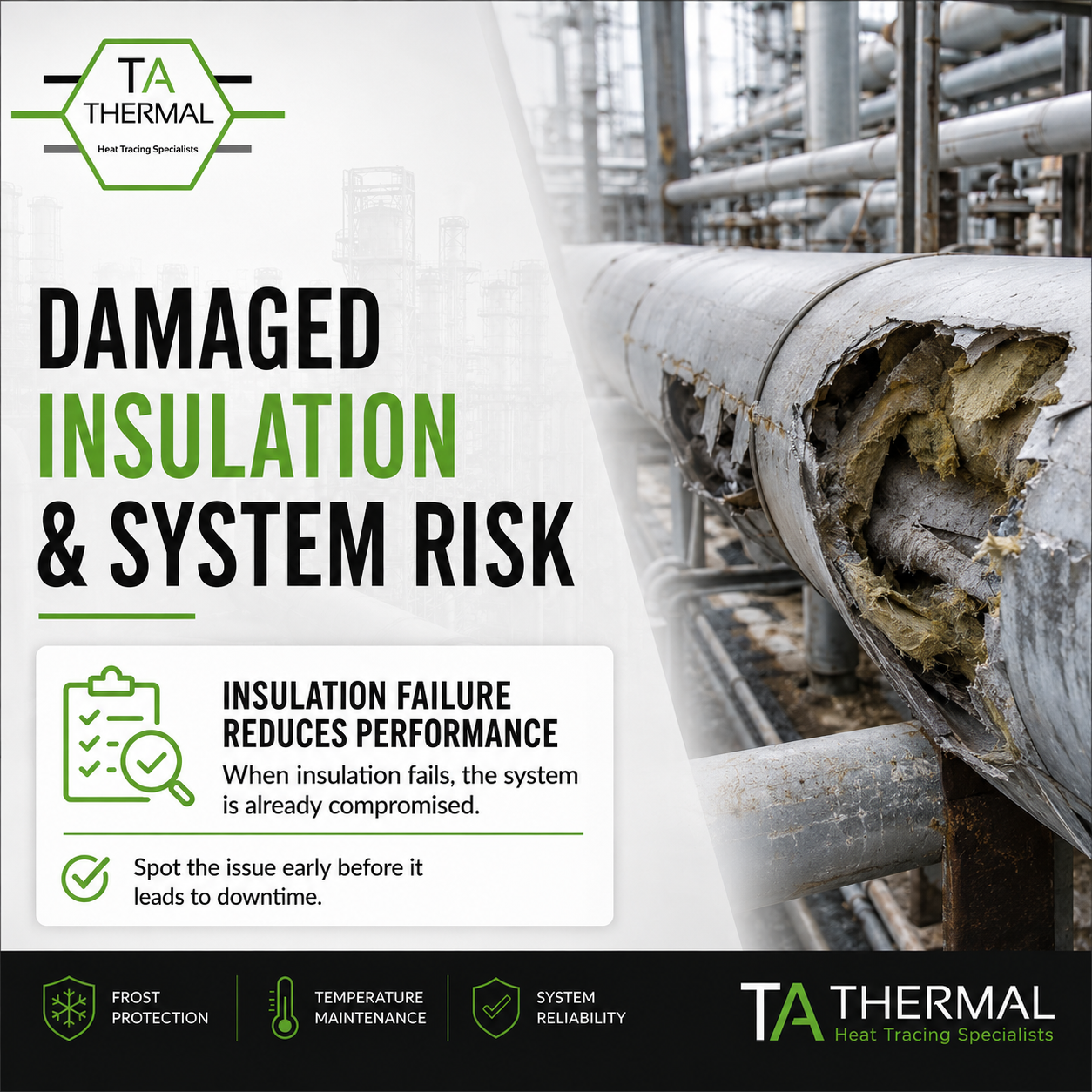
Damaged cladding can allow rain, washdown water or process leakage into insulation. Wet insulation generally performs worse and may promote corrosion under insulation. Moisture can also reach terminations or damaged cable. A cold pipe should therefore prompt inspection of the weather barrier and insulation condition, not only electrical testing.
The insulation must match the design
Changing insulation thickness or material affects calculated heat loss. Compression, poor fitting and unsealed penetrations can reduce real performance. Conversely, additional insulation is not a substitute for checking maximum sheath or surface temperatures, cable ratings and process limits. Any change should be reviewed as an engineering change.
Installation sequencing matters
Trace heating should be tested before insulation and again after insulation work, because cable can be damaged or displaced while covers and cladding are fitted. Warning labels should identify traced assets so later trades do not drill, cut or remove coverings without recognising the hidden electrical system.
What to inspect during maintenance
Look for loose or missing cladding, damaged seals, staining, water entry, compressed sections, exposed pipework and poorly covered valves or supports. Compare the installed insulation with the design or circuit documentation. Repairing the weather barrier may be as important as repairing the heating circuit.
Key takeaway
Trace heating and insulation are a combined thermal system. Reliable performance depends on correct cable output, intact insulation and weatherproof cladding — all matched to the real operating conditions.
Frequently asked questions
Can self-regulating cable work without insulation? It may become warm in open air, but that does not mean it can maintain the design temperature. Most systems rely on specified insulation.
Can insulation cover a trace heating cable? Yes, when installed as designed. Cable type, attachment, maximum temperatures and manufacturer instructions must be followed.
Does damaged cladding affect trace heating? Yes. Water entry and insulation damage can increase heat loss and contribute to electrical deterioration.
The recommended next step is a site survey. TA Thermal can review the asset, existing information, controls, insulation and electrical condition before defining the work required. Call 0115 683 9540 or email info@tathermal.co.uk.