Self-regulating cable varies its local heat output with temperature, constant-wattage cable provides a defined output per unit length, and mineral-insulated cable uses a robust metal sheath for demanding and often higher-temperature duties. Each can be the correct choice when selected and installed for its intended application.
Selection should be made from the full design duty, not from one feature such as watts per metre or maximum temperature.
Self-regulating heating cable
A conductive polymer core changes resistance as temperature changes. Colder sections produce more heat and warmer sections produce less. This local response is useful on pipework with varying conditions and can reduce the risk of local overheating, subject to the product rating and design.
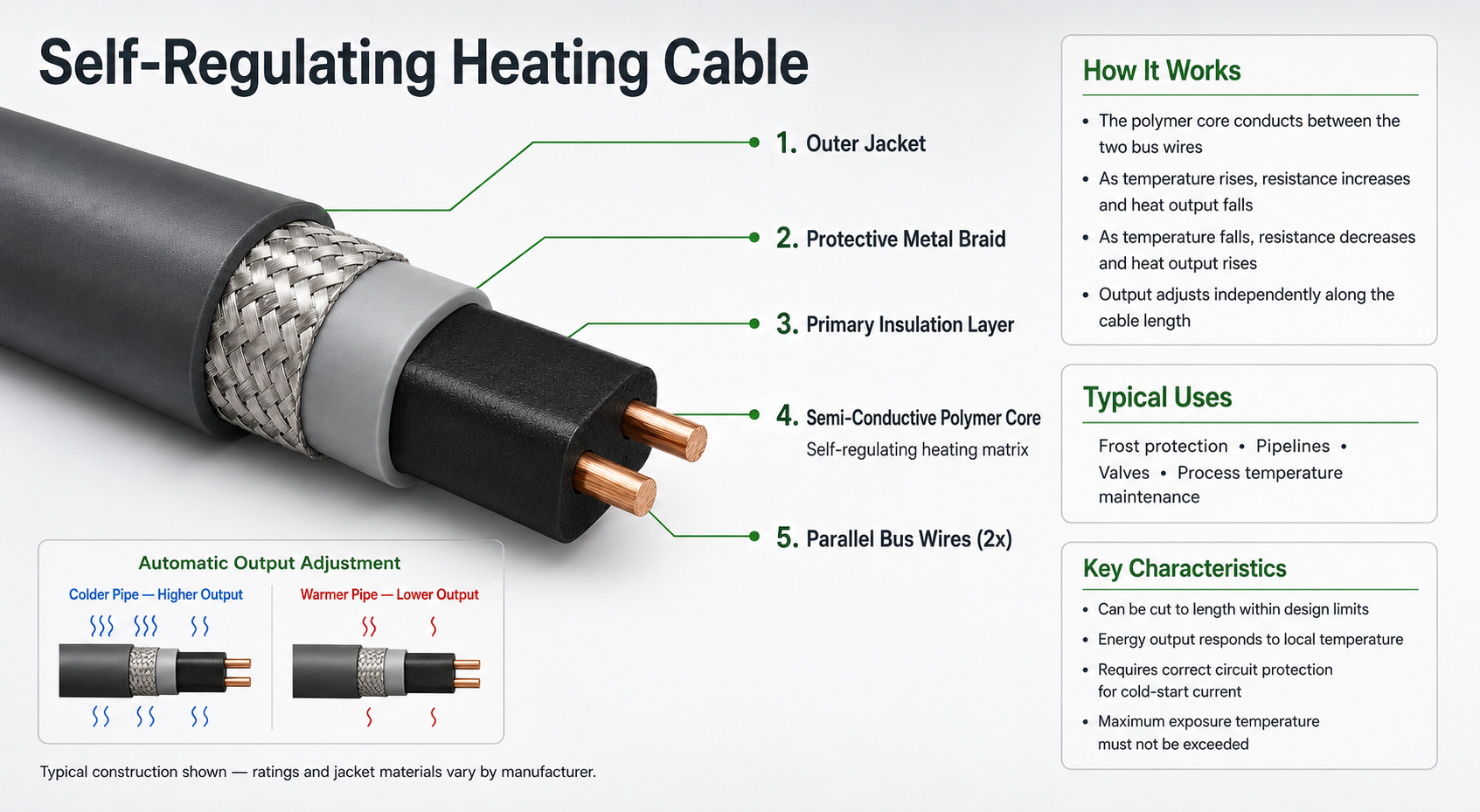
Self-regulating cable is common in frost protection and many process-maintenance applications. Designers still need to check start-up current, maximum circuit length, exposure temperature, chemical compatibility, power connection and control strategy. "Self-regulating" does not mean self-designing or maintenance-free.
Constant-wattage heating cable
Constant-wattage constructions deliver a nominal output along the circuit when energised. Parallel types are used for pipe, tank and equipment frost protection or process temperature maintenance where consistent output is required. Series-resistance constant-wattage cables can suit long lines that exceed the practical circuit-length limits of parallel heating cables, including higher maintain-temperature or exposure duties.
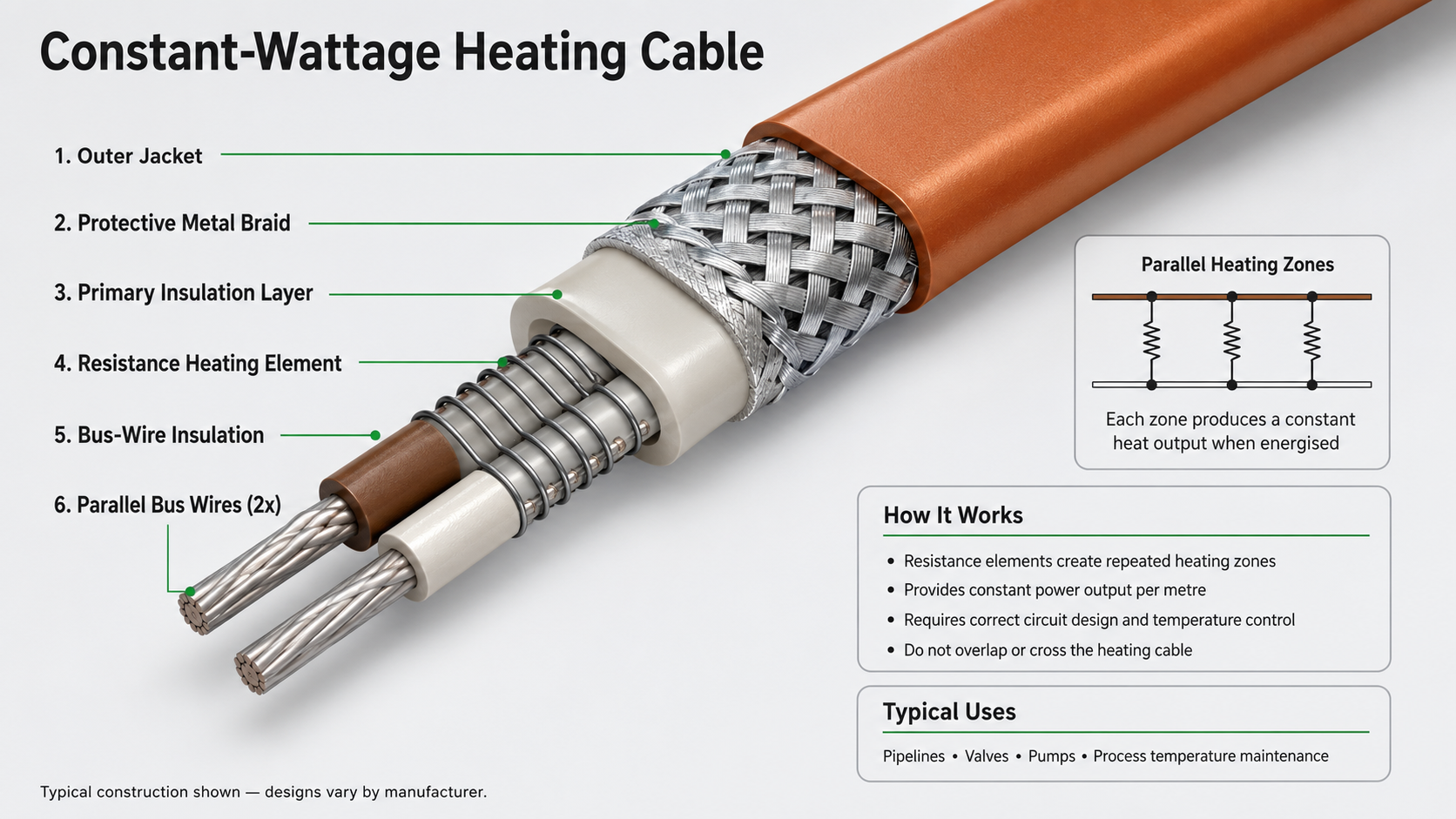
Layout, spacing, crossing restrictions, circuit length and control remain important, and a cable must not be cut or altered except as the specific product permits.
Mineral-insulated heating cable
Mineral-insulated cable typically uses resistance conductors embedded in compacted mineral insulation within a metal sheath. It offers high temperature capability, high possible outputs, mechanical robustness and resistance to harsh conditions when correctly specified. It can be valuable for high-temperature process duties, high exposure temperatures and demanding hazardous environments; examples can include hot process products such as asphalt or bitumen.
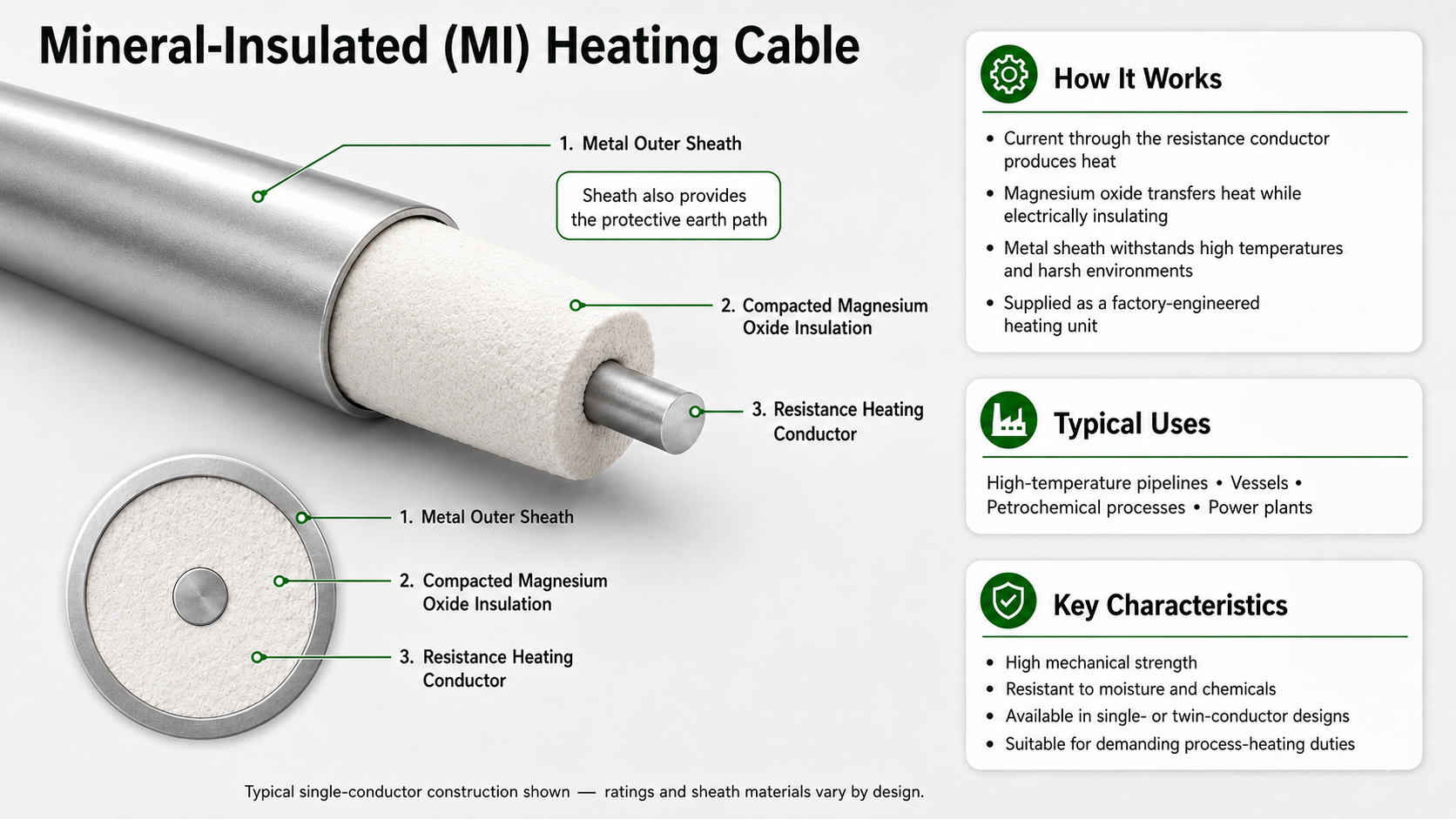
MI systems require specialist design, handling and termination. Bend limits, sheath material, cold leads, joints and moisture control are critical, and circuit fabrication may be more bespoke than with polymeric cable.
How to choose
Begin with maintain and exposure temperatures, calculated heat loss, circuit length, voltage, start-up conditions, area classification, chemical environment, pipe material, control accuracy and maintenance access. Then compare approved cable families and accessories. The termination system and local competence matter as much as the cable construction.
Avoid misleading comparisons
A lower purchase price may be offset by more circuits, controls or installation time. A high output may exceed surface-temperature limits. A cable with a high maximum exposure rating may not provide the required output at the maintain temperature. Whole-life suitability is more useful than a single headline specification.
TA Thermal remains manufacturer-neutral
TA Thermal is not presenting one manufacturer as the answer to every duty. The business works from the application and the three main cable categories — self-regulating, constant-wattage and MI — before selecting a suitable approved system. This keeps technical suitability ahead of supplier promotion.
Key takeaway
Self-regulating, constant-wattage and mineral-insulated cables solve different combinations of temperature, environment and control requirements. The correct answer comes from the design duty and approved system, not a universal winner.
Frequently asked questions
Can self-regulating cable cross over itself? Only where the exact product and manufacturer instructions permit it. The complete design and maximum temperature limits still apply.
Which cable uses the least energy? Energy use depends on heat loss, output, controls, duty cycle and insulation. Cable category alone does not determine annual consumption.
Is MI cable always for hazardous areas? No. Various cable types may have suitable approvals. Selection must match the zone, temperature class, gas or dust group and installation requirements.
The recommended next step is a site survey. TA Thermal can review the asset, existing information, controls, insulation and electrical condition before defining the work required. Call 0115 683 9540 or email info@tathermal.co.uk.